Peer Review of the Project Callisto Reports on Cold Fusion
A review of the Callisto project’s “Electrochemical Loading Research Final Report” (September 2026) and its companion “High Pressure Loading Final Report” (February 2024), neither of which was submitted to peer review before publication
Reviewers
Jean-Paul Biberian, Francesco Celani, Daniel Fargue, Marc Fleury, Frank Gordon, David Nagel, Jacques Robert, Jacques Ruer, Edmund Storms, Paul Werbos, Dr.-Ing. Paul Wilhelm, ████████, ████████, ████████, ████████, ████████
A group of researchers in condensed matter nuclear science. Reviewers who preferred not to be named are shown redacted, as in the reports under review.
October 2026
Preface
The Project Callisto reports describe a well-funded program that ran hundreds of experiments, mostly outside the parameter space the reports themselves identify as necessary for the effect they set out to test in low-energy nuclear reactions (LENR, also known as cold fusion). The program chose not to measure the nuclear product its own text identifies as decisive. The reports reach conclusions that exceed the information they provide, and they were published without peer review. They should be read for what they are: the closing memorandum of a private program, written for its sponsor, that failed to find excess heat under the conditions it chose to test. They should not be read as a scientific finding on whether low-energy nuclear reactions exist. That question is closed: they do, and what Callisto proves with its null results is that replication remains difficult and sporadic but in no way invalidates the positives. The recent peer-reviewed literature, together with the industrial and public programs now under way internationally, further suggests it is being answered by other means. The review that follows is simply the one the reports did not ask for or receive, yet deserve. A partial or full release of the Callisto data, which is missing from the report, would allow it to be completed, and might yet provide support for conclusions that are, at present, unsupported.
Abstract
In September 2026 Project Callisto, a privately funded nine-year program, published two reports (381 and 226 pages) concluding that no anomalous heat exists in palladium-deuterium systems and recommending that LENR research be terminated. The reports were released without peer review, and as released they would not pass an editorial desk, let alone a referee. This document is the review they did not receive. We examine both reports against their own text, the primary literature and the current peer-reviewed record of research by scientists within the LENR community. Our first and principal finding is an omission: Callisto ran hundreds of sealed cells for weeks, states that its mass spectrometry could resolve helium-4 from deuterium, and never measured helium in a single cell. By the pressure report’s own conversion (1 J of fusion heat is 0.5 pmol of helium), a 10 mW excess sustained for a week would have left some 10¹⁵ helium atoms, a few parts per million, in a sealed headspace of a few tens of millilitres: about a thousand times the detection limit the report itself quotes for Miles, and several times the helium content of commercial deuterium gas. The cheapest and most decisive measurement of the program was available and was not made, so the null result rests entirely on calorimetry whose stated error budget (1 to 10 mW) describes pulse detectability under ideal conditions, not the steady-state accuracy of the instruments on which most cell-hours were accumulated. Its “Fleischmann-Pons replications” used ten times the original electrolyte concentration, open beakers with RTDs, no reported loading and durations of hours rather than months. No replication of a positive protocol reached the D/Pd loading of 0.9 that the report treats as a prerequisite; where the loading is documented at all, as in the McKubre replication, it sat at 81 to 86 %. The cells that did exceed 0.9 were novel conditions of Callisto’s own design, and no helium was sampled in them either. The report’s account of its dealings with Edmund Storms does not fit Storms’ own public account. The report does not cite two peer-reviewed results of 2025 and 2026 (Physical Review X; Nature Communications) showing that, at the lowest beam energies, deuteron-deuteron reaction rates in metals exceed the bare-nucleus expectation by many orders of magnitude, and that electrochemical loading of palladium raises them further. The reports do not name their sponsor; we note what the public record says about who it is likely to be, and that the release coincided with the start of DARPA’s MARRS program and with the first public account by a former NSF program director of how federal funding was handled in 1989. We conclude that Callisto’s null result is real but confined to conditions the field has long said are insufficient, that a recommendation to terminate a field would not survive a referee who had read the reports’ own figures. We finish with a plaidoyer arguing that the case for substantially increased funding of the field is stronger in 2026 than at any time since 1989.
1. Introduction
On September 8 2026 a group calling itself Project Callisto published two reports on the website callisto.report, presented as a systematic study of LENR (cold fusion) experiments. The first, the High Pressure Loading Final Report, is dated 11 February 2024 and runs to 381 pages; it describes gas-phase loading of palladium with deuterium at pressures up to 600,000 psi. The second, the Electrochemical Loading Research Final Report, carries the date 4 September 2026 on its cover and runs to 226 pages; it describes electrolytic experiments with palladium cathodes in heavy water. Both conclude that no anomalous heat exists. The second ends with the sentence: “We therefore recommend terminating LENR research” (p. 189). Neither report was peer reviewed, which is the standard for work published in technical journals and the minimum one would expect before a sweeping recommendation of that kind.
The present document is a peer review of those reports and of that conclusion. They were placed before the public with no referee; what follows is the review any journal would have sent them. It was written by a group of physicists, engineers, investors, scientists, public figures and electrochemists who have worked in condensed matter nuclear science for, in some cases, more than thirty years. Among the contributors are experimentalists who, from 1995 to 2000, worked at the French Atomic Energy Commission (CEA) in Grenoble on the two ICARUS 2 cells that Martin Fleischmann personally supplied, with the instructions to operate them, when Fleischmann and Pons were at Sophia Antipolis near Nice. Those cells reproduced the Fleischmann-Pons excess heat, including the boil-off regime, and the results were published [1]; see also J.-P. Biberian, J. Condensed Matter Nucl. Sci. 21 (2016), on the ICARUS-2 cells. Others have organized the international conferences of the field (ICCF) and know personally every experimenter whose work Callisto set out to replicate. Some of us are the experimenters whose work Callisto set out to replicate. We have operated the calorimetry that Callisto describes; that is how we can see where its description departs from what was actually done.
We have chosen to sign as a group of reviewers. Everyone listed on the title page either contributed to this review or directly endorses its conclusions. We do not object to anonymity in itself; many of Callisto’s contributors withheld their names and that is their right. We object to something else, discussed in section 9. Everything in this document can be checked against the page numbers given, which is more than can be said for a recommendation to terminate a field of research.
We have read both reports in full. This review concerns mainly the electrochemical report, which is the one that addresses the Fleischmann-Pons experiment and the work of people we know. We refer to the pressure report where it bears on the argument. Page numbers without further indication refer to the electrochemical report; “pressure report” refers to the February 2024 volume; “summary PDF” refers to the short summary of the electrochemical effort on the website.
Our conclusion is simple. Callisto ran a very large number of experiments, mostly of its own design, under conditions that its own text shows did not meet the prerequisites stated by the authors it set out to test. It never measured helium, the nuclear product on which the strongest evidence in the field rests, although it had the instrument and the sealed cells to do so. Its account of its dealings with at least one of the researchers it claims to have replicated, Edmund Storms, does not fit his. And it does not cite two peer-reviewed results published in 2025 and 2026, in Physical Review X and Nature Communications, that bear directly on its subject; the Nature Communications authors describe, in their own careful phrasing, “a previously unrecognized regime of low-energy nuclear reactions (LENR) in solids”. Both are publicly funded results obtained for a small fraction of what Callisto spent.
The reports do not say who paid for them. The public record, discussed in section 9, points to a single private sponsor whose science adviser, Lowell Wood, is on the contributor list and whose 1989 observation at Livermore the pressure report says “strongly motivated” the program. Lowell Wood was an intimate of Edward Teller and both knew LENR was real back in 1989. We believe Wood acted in good faith when he set out to replicate those results and secured the lavish funds to do so from their “private sponsor”. We have contacted members of the project, those whose names we could read, and found them open, amenable and well-meaning; we have no quarrel with them, they too acted in good faith. Their null result is real but narrow. Null results of this kind are abundant in the field, replication of the effects still being finicky, and they implicate only the conditions under which they were obtained. The recommendation to terminate a field of research, based on those null results, is not a scientific conclusion. We also find the timing of the release, two years after the program was shut down, hard to explain by anything in the reports themselves: it coincides with renewed public funding in the United States, with mainstream results in top-tier journals, and with the first public account, by one of us, of how federal funding of this field was handled in 1989 under the direction of Ed Teller and Julian Schwinger. Read as a submission, the reports would not clear an editorial desk, much less peer review: six hundred pages, no data, no loading where it matters, no nuclear product, and a recommendation that outruns the evidence by the width of a field. The sections that follow say where.
2. General remarks
Who and when. The website states that the program ran from 2015 to 2024 with “more than 100” contributors, and the electrochemical report says its own work took place between 2017 and 2024 (p. 11). The website lists 49 names; the rest are shown as black bars, “at their request”. Neither report carries an author’s name, although one of its authors was gracious enough to reach out to us in private. The acknowledgements section of the electrochemical report reads, in full: “[Redacted. Names may be added in a later revision of this document.]” (p. 225). No institution, no laboratory location and no source of funding is given anywhere. The pressure report thanks “the sponsor”, in the singular, for “extraordinary treasure and personal attention” (p. 379). Six pages of the pressure report (chapter 3, pp. 17-22) are marked “[Section Omitted]” without explanation. Lowell Wood appears in the list of contributors, and the pressure report states that his 1989 observation at Livermore “strongly motivated” the program (p. 239).
Who paid. Neither report names its sponsor. What the public record shows is this. Lowell Wood has been Bill Gates’ science adviser for two decades, through Intellectual Ventures and the Gates Foundation [15]. In November 2014 Wood accompanied Gates on a visit to the ENEA laboratory at Frascati, where Vittorio Violante’s group briefed them on its palladium-deuterium work [15]; Callisto was formed in 2015. Wood’s name is on the contributor list, his 1989 Livermore observation, in the pressure report’s words, “strongly motivated” its investigation (pressure report, p. 239), and the Appreciation chapter thanks a single sponsor for “personal attention”. We draw the inference that most readers will draw, and we label it as an inference. The same investor holds well-known stakes in nuclear fission and in solar; we do not imply a conflict of interest as we repeat that we believe they all acted in good faith, from Lowell Wood, who saw the inception of Cold Fusion at LLNL on down to the young scientists we have talked to. We note it only because it bears on a view, discussed in section 11, that energy may not be the main application of LENR. The reason it matters is not the name. It is that a document recommending the end of a field of research is the closing memorandum of a private program, written for its private sponsor, and is now being circulated publicly as if it were the authoritative findings of the scientific community.
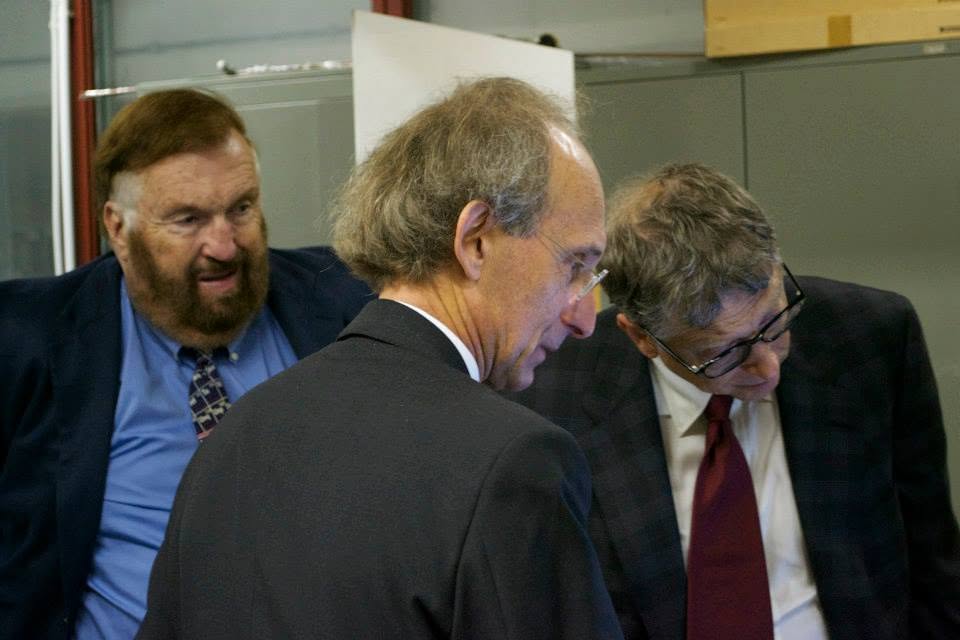
Lowell Wood (left), Vittorio Violante (centre) and Bill Gates during the visit to ENEA Frascati, November 2014. ENEA photograph of the visit, published by ENEA [15].
Resources. This was a large, well-funded team with access to expensive equipment. They built their own calorimeters and data acquisition systems, including a 100-cell parallel array. The engineering, particularly on the pressure side, is of high quality and we say so without reservation; these were highly trained engineers. We are impressed, and not just by the money but also by the talent. We would rather build bridges to these individuals all the way up to their sponsor. The cost is not disclosed. From the stated headcount, duration and 45,000 square feet of laboratory, our own estimate of the outlay is in the hundreds of millions of dollars; at Bay Area rates the salaries alone, for a hundred people over nine years, are of the order of $250 million. That is some fifteen times the combined budgets of the 2023 ARPA-E LENR program ($10 million across eight teams, which Callisto itself cites) and the European CleanHME consortium (about €5.6 million from the EU), and about the cost of a small satellite mission, spent to arrive at “we recommend terminating LENR research”. There is something lurid about watching so much money, so many years and so much talent end in a conclusion so narrow.
Presentation. The reports are well written and pedagogical. Someone who does not know the field can follow the science, and the authors are clearly proficient at what they do. The website is professional and persuasive; several of us enjoyed reading it. It projects the image of high-quality work, which is exactly why it needs a detailed peer review rather than an outright dismissal.
Scope. The scope is narrow. Both reports concern palladium and deuterium, with one exception. The pressure report says on its first page: “We have not been looking for protium-based reactions, e.g., we have not pursued reports of LENR in nickel-protium systems.” The exception is a short test of the Kitamura-Takahashi PNZ7 nickel-palladium-zirconia nanocomposite (pressure report, pp. 228-233): three calorimetric runs, one per material batch, comparing hydrogen and deuterium (pressure report, p. 231), with the loading measured in hydrogen only (p. 230), on material whose first batch still had all its nickel and palladium bound to zirconium and whose later batches were still not fully oxidised (pp. 229-231), and no helium. Celani’s wires and Mizuno’s reactors are cited in passing and not tested; Iwamura’s permeation transmutation is not addressed at all; plasma stimulation, glow discharge and arc, is absent. Six hundred pages on essentially one material system, studied by the method of 1989, end with a recommendation about the whole field. A narrow null result is not a licence to over-reach in the conclusion. The only conclusion the data support is “the Callisto study failed”.
Method. Callisto classifies its own replications (p. 185). Only two are called “exact”: Staker (2019) and Barham (2023). Eight others (Letts, Staker again, Storms, Energetics, McKubre, Miles, Hubler, Boss) were transplanted into Callisto’s own closed calorimeters with Callisto’s own sample holders. Fleischmann and Pons are described as “more loosely based on literature reports”, a few lines after the same page claims “we replicated all major published electrochemical LENR experiments” (p. 185). The founding experiment of the field was therefore never replicated as such. The SRI and ENEA heat-helium cells and the ICARUS-2 work are not on the target list at all.
Contact with the original authors. Callisto says it corresponded with Staker and Letts, and that Storms “later told us that key information existed outside of his publicly available materials” and supplied samples (summary PDF; p. 137). Edmund Storms has stated publicly that Callisto “never contacted me for advice” [13]. Michael Staker, asked by us, states that he was not contacted by the Callisto team, was not invited into its laboratory, and did not know who was attempting to replicate his experiment [23]. Section 7.5 sets the Storms accounts side by side; section 7.3 gives Staker’s. Callisto did not work with any of the original experimenters in the laboratory. Its own conclusions concede the point: “Replications with the original party involved have been reported to be successful” (p. 189). No such joint replication was attempted before recommending that the field be shut down.
Metrics. The report states that “there are two metrics widely used in the LENR field”, excess heat and COP (p. 23). In research the quantity of interest is the excess power with its uncertainty; the COP is an engineering figure of merit that hides the input power. As Staker puts it, a cell can have a very low COP and still produce a large excess heat per gram of palladium; the real measure is the comparison with a control cell that gives zero excess whatever the input, and raising the input only degrades one’s ability to see the excess [23]. Many of Callisto’s plots give COPs without the input power or an error bar.
Tone. The introduction states that “over-claiming, misinterpretation, and in some cases subterfuge, are directly responsible for the stigma and taboo around LENR” (p. 14), that positive results were “most likely due to … cherry-picking of data, or in the worst case, deception” (p. 14), that the work of Letts and Cravens is “mediocre at best” (p. 17), and that excess heat “appears to have been a red herring” (p. 11). This is not the language of a scientific report, and it is stated before any evidence is presented.
The recommendation. The pressure report says of its own conclusion: “Obviously, this is a belief, not a proven fact. It’s very hard to prove a negative” (p. 371). The short summary PDF on the website says: “We cannot prove that AHE does not exist.” The website says: “Although we didn’t test every possible corner of the parameter space, we consider our null result definitive in the spaces we did search.” The pressure report leaves itself three further exits: “We have not tried to replicate such electrolytic experiments … and can certainly not prove that they failed” (p. 373); “it is possible that LENRs are a purely surface phenomena … this may well explain why none of our gas-based experiments have detected LENR” (p. 376); and its archaeology detectors fail if the energy leaves as energetic particles (p. 377). None of these hedges appears in chapter 9 of the electrochemical report, which ends: “We therefore recommend terminating LENR research” (p. 189). The strength of the claim grows as one moves away from the data.
3. What Callisto did not measure
Across 607 pages, neither report contains a single measurement of helium-4, helium-3 or tritium in an experiment. Not one. The pressure report is explicit: “1 joule of heat corresponds to 0.5 picomoles of helium. The former is easy to detect, the latter is not … detecting 24 MeV of heat is doable, detecting a single helium atom is not. Accordingly, we have focused on heat measurements, not helium ones” (pressure report, p. 9). Its nuclear-detection chapter (pp. 362-368) uses germanium spectroscopy for prompt and delayed gammas and liquid scintillators for any ionizing radiation, the signatures the field has said since 1991 are absent, and finds them absent. The electrochemical report says of helium that “modern equipment is capable of resolving near-equimolar concentrations of deuterium gas and helium-4 (verified by Callisto)” (p. 14), and the website lists a Hiden Analytical mass-spectrometry system among the equipment. Callisto therefore had the instrument. It never used it on a single cell.
This is the central omission of the program, and the arithmetic is Callisto’s own. Take the pressure report’s conversion, 0.5 pmol of helium per joule. A 10 mW excess, the upper end of the 1 to 10 mW error the electrochemical report claims for its closed cells, sustained for one week, is 6 kJ, or about 3 nmol of helium: some 2 × 10¹⁵ atoms, released into a sealed headspace of a few tens of millilitres. The electrochemical report itself quotes Miles’ detection limit as 6 × 10¹⁰ atoms per millilitre (p. 138). Callisto ran hundreds of closed cells for weeks and, by its own account, more than 230 hours at loadings above 0.9 (p. 167) and more than two months in single crystals above 0.9 (p. 171). In metal-sealed, leak-tested cells filled with low-helium gas, as SRI’s were, a helium measurement would have reached excess powers of a fraction of a milliwatt sustained over a week, far below the floor of the calorimetry, and it is immune to every calorimetric artifact the report catalogues: recombiner failure, RTD corrosion, electrolyte level, PEEK charring, diurnal swings. Helium has artifacts of its own (in-leakage, permeation, helium already in the metal and the gas), which is Callisto’s stated reason for not measuring it (pressure report, p. 9), and part of it stays in the cathode until the metal is cycled: SRI found 62 % in the gas at first and 104 ± 10 % after cycling [5]. Those are controllable problems, and SRI controlled them. The report’s answer to this is that measuring helium at the parts-per-billion level against deuterium is “incredibly challenging” without concentration techniques (p. 14). It is challenging, and Miles, McKubre and Violante did it in the 1990s and 2000s with the budgets of a Navy laboratory, a contract research institute and a national agency, which were small fractions of Callisto’s. A helium mass spectrometer capable of resolving He-4 from D2 costs between a few hundred thousand and one million dollars.
This matters because the heat-helium correlation is the field’s strongest nuclear evidence and the one that is immune to every calorimetric objection Callisto raises. Miles at China Lake [4], McKubre at SRI [5], and Apicella, Violante and colleagues at ENEA Frascati [6] independently found helium-4 in proportion to the excess heat, at roughly the rate expected for the D + D → ⁴He channel (within an order of magnitude in Miles’ 1993 paper; 104 ± 10 % at SRI once the cathode was cycled). Tritium was measured at the Bhabha Atomic Research Centre, at the National Cold Fusion Institute and at Los Alamos [7]. Callisto acknowledges the helium correlation on pages 16, 18 and 138, names atmospheric contamination as the objection, and never tests it. The electrochemical report’s own introduction says it best: “Nuclear products are unambiguous, whereas excess heat can be generated from” many sources (p. 11), and praises ARPA-E for shifting its program toward them. A program with these resources could have put a mass spectrometer on the effluent of every closed cell. It did not.
The reports also record their own unexplained events and drop them because they did not recur: a single-crystal run with a COP of 1.05 (BE1320, p. 175), and sporadic heat spikes in a passive cell at 100,000 psi of deuterium at 50 °C whose source “we could never definitively locate” (pressure report, p. 268). The pressure report’s own Table 1 (p. 215) records blistering in 17 of 19 polished foils loaded with D₂O against 0 of 10 loaded with H₂O, and the surrounding text says “no isotopic contrast is observed” (p. 214). Hydrogen and deuterium kinetics differ and we do not offer this as evidence of LENR; we offer it as an example of a caption that the report’s own table contradicts for polished foils (light-water foils did blister once roughened, 4 of 5), and of exactly the samples on which helium should have been sampled. Nano-explosions, described to us in private communication by members of the Callisto team, have been widely reported across the field, by Storms and by Mosier-Boss and Biberian among others. Non-recurrence is not a dismissal of a positive observation, just a failure to replicate it.
4. What the electrochemical report contains
The report has nine chapters. Chapter 1 (pp. 7-19) opens with three pages on the climate crisis, then reviews Fleischmann and Pons, McKubre, Storms, Staker, Letts and Cravens, SPAWAR, the Naval Surface Warfare Center at Indian Head, Miles, and Google. Chapter 2 (pp. 20-46) describes calorimetry: open and closed cells, a commercial Setaram MS80 Calvet calorimeter, a home-built “high-throughput” calorimeter (HTcal) based on a thermal bar, and an “ultra-high-throughput” array (UHTP) of 100 isoperibolic cells. Chapter 3 (pp. 47-72) reviews every known method of measuring hydrogen loading in palladium and settles, as everyone in the field has, on the resistance ratio, supplemented by optical reflectance on thin films. Chapter 4 (pp. 73-86) is a density-functional study of palladium hydride. Chapter 5 (pp. 87-89) covers surface preparation. Chapter 6 (pp. 90-98) covers current density, temperature, surface deposits, loading enhancers and electromigration. Chapter 7 (pp. 99-160) contains the replications. Chapter 8 (pp. 161-184) contains Callisto’s own experiments: mechanical stimulation, arsenic and ammonia additives, single crystals and alloys. Chapter 9 (pp. 185-189) gives the conclusions.
The headline numbers are “over 500 samples” and “over 200,000 hours of total calorimetry time”, which the executive summary describes as “of a similar magnitude as all known LENR efforts combined” (p. 1). The report’s own Fig. 9.1 (p. 186) shows how those hours divide: about fifteen of some twenty-three calorimeter-years were spent in HTcal and about six and a half in the 100-cell array. The number that matters, the number of cell-hours spent at a loading above 0.9, is given nowhere in the report. We return to this in section 6.
Two chapters deserve a word of recognition. The loading review in chapter 3 is a useful compilation. The DFT work in chapter 4 is competent and should be published independently, with two caveats: it models palladium hydride, not deuteride, and its 32-atom cell does not reproduce the two-phase region of the isotherm, as the authors admit (p. 83). Its conclusion that electrochemical loading has a ceiling of “70-80 %” (p. 86) is stated for cathodes without Tafel poisons, which the same chapter exempts (p. 85); arsenic takes Callisto’s cells above it. The point stands in a weaker form: without poisons, most of Callisto’s cathodes sat below the threshold the literature says is required.
5. Calorimetry: what the report gets wrong about Fleischmann and Pons
5.1 The claimed error
The central methodological claim of the report is on page 24:
“By performing calorimetry using various devices, we concluded that based on the fundamental limitations listed above, errors on the order of 1 to 10 mW in closed system calorimeters and several hundred mW in open system calorimeters are to be expected.” (p. 24)
This sentence is asserted, not derived, and it mixes two different quantities. The 1 to 10 mW figure is the detectability of a heat pulse under ideal conditions (pp. 32, 44). The steady-state accuracy of the instruments is another matter: HTcal is quoted at about ±2 % (summary PDF, p. 6); the 100-cell UHTP array screens for events of 100 mW or more (p. 35), was calibrated with a staircase from 150 mW to 2.5 W and then operated up to 5.6 W (pp. 42-44), above the range it was checked in, and the unknown position of the heat source “typically bounds the excess heat by ±10 %” once an excess is seen (p. 44); for the Setaram MS80, a differential instrument, equal input powers in the two cells produce false differential signals of 3 % when both are electrochemical, 10 % when one is a resistor, and “up to 20 %” when the heat source is in the headspace (p. 28), a position effect Callisto calibrates out with resistors (p. 27) but which sets the floor for any heat released where the resistor was not. The same chapter states that a 5 mW pulse “would be below the noise floor (driven by diurnal swings and recombiner variations) of a typical experiment” (p. 44). In the Barham replication the control cells varied by ±0.5 W on 15 W of input, and that 3 % became the detection limit. A report that opens with “1 to 10 mW” and then detects at 3 % of input has not derived its error budget; it has quoted its best case.
The claim that open cells are good only to “several hundred mW” is equally unsupported. Fleischmann and Pons documented their open Dewar calorimetry in a 56-page paper [2] and a later paper on the boil-off regime [3]; their stated precision, which was contested at the time and should be read in their own words in the calibration section of [2], is of the order of a milliwatt on inputs of several watts. This was achieved by using calibrated thermistors rather than platinum resistance probes, by keeping the thermistors out of direct contact with the electrolyte, by including the heat capacity of the cell in the differential equation, and by calibrating with a heater pulse in every cycle. One of us operated, with Lonchampt at the CEA, the ICARUS cells built to this design, and their behaviour matched the published description [1].
5.2 The verdict rests on the 1989 note
The conclusion of the Fleischmann-Pons section states:
“With the very limited data provided in Fleischmann’s paper [26] – notably absent of any electrochemical or calorimetry figures – it is impossible to uncover the root cause of the discrepancies between their experimental outcome and our experimental outcomes.” (p. 104)
Reference [26] is the 1989 preliminary note in the Journal of Electroanalytical Chemistry, which indeed contains almost no figures. The 1990 paper by Fleischmann, Pons, Anderson, Li and Hawkins in the same journal (volume 287, pages 293-348) is almost entirely calorimetry: the full heat-balance equation, the calibration procedure, the treatment of the heat capacity, the evaporation term, the radiative term, and page after page of temperature and power figures. Callisto summarizes that paper in its introduction (p. 15: Dewar cells, resistance-heater calibration, low and high current density) and has it in its bibliography, but its verdict on Fleischmann and Pons rests on the 1989 note and never engages the 1990 heat balance, calibration or error treatment, which is where the claims actually rest. Grounding a verdict on the preliminary note while the full paper sits in one’s own bibliography is not an analysis of Fleischmann and Pons.
5.3 Isoperibolic calorimeters and temperature probes
The report criticizes isoperibolic calorimeters on the grounds that the heat transfer to a probe in the electrolyte can change with bubbling and that “submerging temperature probes into the highly alkaline, often warm, electrolyte for extended durations can result in their degradation” (p. 25). Two remarks. First, Fleischmann and Pons did not use platinum resistance thermometers; they used thermistors, as Callisto itself notes on page 15, and in the ICARUS cells the thermistors were housed in glass sleeves, not bathed in the electrolyte. Second, Callisto’s own 100-cell UHTP array is an isoperibolic calorimeter with two RTDs immersed in the electrolyte, operated up to 5.6 W, above the top of its calibration staircase (pp. 39-44). The report’s chapter 9 lists RTD failure in corrosive electrolyte as one of its own most frequent artifacts (pp. 186-187), and a single faulty RTD produced 64 % of all readings above the 100 mW threshold in its showcase 80-cell campaign (p. 123). The design objection Callisto raises against the field applies to its own array.
5.4 Differential calorimetry against a blank
The Setaram MS80 measures the difference between an active cell and a reference cell, which Callisto fills with a platinum cathode or light water. The report’s own calibration shows why this is a poor way to look for small effects: with identical input powers, the two positions differ by 3 to 20 % depending on where the heat is released (p. 28), because, in Callisto’s words, heat sources couple differently “to the thermopile and to the loss pathways” (p. 28). The correct procedure is to calibrate a given cell in a given position with a resistor and to compare the active run with that calibration. Comparing two cells adds the uncertainties of both. This affects the Hubler and Energetics replications, Callisto’s own Storms-type pellets, and part of the single-crystal work, all done in the MS80 (Storms’ own samples and many single crystals ran in HTcal, pp. 137 and 175). Note also that the MS80 saturates at ±500 mW (p. 134), so the one large event seen in a Storms replication was never fully measured.
5.5 Transients
The report states that “most LENR studies neglect to account for the time-dependent response of the calorimeter” (p. 25). Fleischmann and Pons did not neglect it: the heat capacity of the cell appears explicitly in their equation and the response to a heater pulse is used to extract it. Callisto, by contrast, admits in the Miles section that its convolution correction “was not implemented at the time of this experiment” (p. 140), and the COP traces in chapter 7 show large spikes at every power step. One cannot reproach others for a correction one applied only late in one’s own program.
5.6 Closed cells are not free of artifacts
Callisto’s preference for closed cells with recombiners is reasonable in principle. In practice, the report documents that its closed cells produced “nearly 30 excursions” in a single 90-day run, all attributed to recombiner failure (p. 115); that a recombiner failure in a Miles replication led to a detonation that destroyed a calorimeter channel and corrupted the neighbouring ones (p. 139); that PEEK components charred inside a Storms replication (p. 134); and that recombiner malfunction is the most frequent source of false signals in all its closed systems (p. 186). The report then reasons as follows:
“We deduce that previous researchers, often equipped with fewer diagnostics and less redundancy, must have encountered similar false signals.” (p. 189)
This is an inference from Callisto’s own artifacts to everyone else’s data. It is not a measurement; it is an inference. Fleischmann and Pons and Miles did not use platinized-carbon recombiners in a pressurized headspace; the artifacts of that design are Callisto’s, not theirs.
6. Loading: the prerequisite was not met where it mattered
The report adopts the field’s central empirical rule: “it is commonly accepted that ≥ 90 % deuterium loading is necessary to foster an environment conducive to AHE” (p. 90). McKubre’s conditions, which the report quotes (p. 104), are a loading above 0.9, a current density above 100 mA/cm² and an incubation time of at least a week, all three together. What loading did Callisto achieve?
Without additives, the natural maximum is “generally under 80 %”, 73 % for deuterium in thin films (chapter 3 and summary PDF).
With arsenic added within the first twenty minutes, peak loadings of 92 to 98 % are reached, but most of these figures are for hydrogen in light water, deuterium loads lower, and “the longevity of this inhibition only lasted for two to three hours on average” (p. 96).
The DFT chapter states that experimentally “the loading is observed to have an upper bound of approximately 0.7-0.85” (p. 85) and concludes to “a maximum 70-80 % hydride loading by electrochemical means in Pd” (p. 86), poisons excepted.
Let us concede the strongest counter-evidence plainly, because the rest of the argument depends on it. Callisto did hold loadings above 0.9 for long periods: closed cells with arsenic at 0 to 15 °C stayed at or above 90 % for more than 230 hours (p. 167), and single crystals under alternating current stayed above 90 % for “well over two months” (p. 171); by gas loading the pressure program reached 100 % (pressure report, p. 3). In none of these did Callisto see excess heat. Three things follow, and only three. These were new conditions of Callisto’s own devising, not replications of any positive protocol. Nobody sampled helium in them either. And they were a small part of the program.
Now look at the replications. In the Fleischmann-Pons section no loading is reported at all. In the McKubre section the additives that gave McKubre his loading gave Callisto nothing (“we did not find a noticeable increase in loading with any of these additives”, p. 106), and Callisto’s own Fig. 7.6 (p. 108) gives the loading of those same calorimetric runs: means of 81 to 86 %, below the 0.9 the same report treats as the threshold. In the Staker section Callisto writes: “we concede our loadings did not remain as high as reported by Staker” (p. 119); the cells stayed “above 80 %”. In the Boss replication the palladium shell loaded to 75 to 80 % (p. 145). In the Hubler replication Callisto does not state its loading; Hubler’s own was 0.7 (p. 126). No replication of a positive protocol reached a documented loading of 0.9, and the report never says how many of its 200,000 hours were spent there. A null result obtained under conditions that the hypothesis says are insufficient is not evidence against the hypothesis.
McKubre reported that 61 % of his cells exceeded 0.9 (p. 105, quoting the 1998 EPRI report). Callisto never states what fraction of its cells did. That single number would have told the reader more than the 200,000 hours.
There is a further point about loading that the report does not engage, and it goes back to the founding paper. Fleischmann and Pons argued in 1989 that the electrochemical overpotential at the cathode surface is equivalent to an enormous deuterium fugacity, a chemical potential that no static gas cell can approach: in that language, the 600,000 psi of the pressure program, impressive as engineering, is a modest number. Electrochemistry is not a clumsy way of reaching the pressures of a gas rig; it reaches a regime the gas rig cannot. The electrochemical report nowhere states the overpotential at which its cells ran, and its bulk loadings, stuck near 0.8 in the replications, are what one expects when that regime is not reached. A gas-phase null and an electrochemical null at 0.8 are two measurements outside the regime the hypothesis specifies, and the report presents them as a search of the whole space.
Loading is, moreover, only one of the material variables. The experimenters who saw the effect have said for thirty years that it depends on the batch of palladium. McKubre has said that his best results came from particular batches of wire, Fleischmann and Pons relied on Johnson Matthey palladium that was reliably active, and Storms found the same batch dependence and built his later work on the idea that a nuclear-active environment, a particular defect or surface structure, has to be present and can be manufactured [19]. There are many reasons to believe that the microscopic (indeed nanoscopic) preparation of the samples is key. Callisto’s materials chapter does not mention batch dependence, its replications used as-received commercial wire, without further details, and the pressure report concedes the point in its own words: “It’s our search over materials that is the least complete” (p. 375). Storms also notes, from his own close involvement with an earlier program of the same sponsor, that the most experienced calorimetrist in the field was within reach and that “a close collaboration was apparently stopped at a higher level” [20]. The same pattern, published recipes transplanted without the experimenter, recurs in Callisto.
7. The replications, in Callisto’s own words
7.1 Fleischmann and Pons (pp. 99-104)
Callisto describes the original experiments correctly: 0.1 M LiOD, rods of 1, 2 and 4 mm diameter and 10 cm length, current densities from 8 to 512 mA/cm², Dewar calorimeters (p. 99) with thermistors (p. 15), and prolonged polarisation (p. 99). It then describes its own “nominal replications”:
“For these experiments, we applied high currents (>500 mA) to large palladium samples (>10 g) for various durations. These tests were done in open beakers with 35 ml of 1 M LiOD electrolyte, with the heat being measured in an isoperibolic calorimeter with an RTD temperature sensor placed in the electrolyte near the cathode. … Some experiments lasted less than an hour, while others ran for over 100 hours.” (p. 100)
Every parameter is wrong. The electrolyte is ten times too concentrated. The cathode is specified by mass only, so the current density is unknown; “>500 mA” on “>10 g” fixes no current density: at exactly 500 mA on 10 g it would lie between about 15 mA/cm² (1 mm wire) and 120 mA/cm² (a compact lump). The calorimeter is an open beaker with an RTD, which by Callisto’s own standard is good to “several hundred mW”. No loading is reported. And the durations are hours. Fleischmann and Pons charged their cathodes for weeks and reported excess heat only after prolonged polarisation, typically weeks to months [2]; Callisto’s own McKubre section quotes an incubation time of at least a week (p. 104). The remaining Fleischmann-Pons “groupings” are a test of machine-shop cutting fluid, oxygen bubbled under the cathode, and discharges at “100 W and several kilowatts (up to 15 A, 300 V)” that produce a glowing electrode and a plasma (pp. 100-103). None of this is the Fleischmann-Pons experiment.
The pressure report explains where the high-power experiments came from. Lowell Wood’s 1989 experiment at Livermore ended with a glowing cathode and a shattered quartz cell (pressure report, p. 241); “after Callisto electrochemical loading spent 3 years running LLNL replications without (yet) observing AHE, Callisto investigated potential classical (non-nuclear) explanations and found plasma electrolysis to provide a reproducible explanation” (pressure report, p. 239). How those three years relate to the forty “Fleischmann-Pons replications” counted on the website is not stated anywhere.
The section’s own conclusion reads: “Whether this is due to insufficient details provided in the original studies or because the effect itself is not grounded in physical reality remains technically inconclusive” (p. 104), followed two sentences later by the claim that the testing “strongly suggests that no LENR effect can be reliably observed under any reasonable and experimentally obtainable conditions”. The two sentences sit uneasily together.
7.2 McKubre (pp. 104-108)
Several of us knew Mike McKubre from the mid-1990s onward. Callisto rightly describes his SRI work as the best documented in the field: 3 mm rods annealed at 850 °C, 1 M LiOD with silicon or aluminium additives, current densities of 300 to 600 mA/cm², closed mass-flow calorimeters accurate to 50 mW or 0.5 %, and durations of hundreds to thousands of hours. Callisto replaced the 3 mm rods with 0.5 mm wires of 28 mm length, replaced the flow calorimeter with HTcal, and used additives that in its hands produced no loading enhancement (p. 106). It did match the current density (about 0.1 to 0.8 A/cm²) and ran for several hundred hours (p. 107). Callisto’s Fig. 7.6 (p. 108) shows the loading in these same runs: means of 81 to 86 %, below 0.9. Two of the three McKubre conditions were met and the third, the one McKubre said was decisive, was not; the null tells us little about McKubre.
Callisto also quotes McKubre’s 1998 remark that “during times when axial current is passing both loading information and calorimetry were seriously inaccurate” (p. 105) and repeats it in its conclusions as if it were a retraction of the 1994 results. It is not. The report’s own page says the remark comes from a later experiment with axial current, and McKubre’s helium measurements, which Callisto mentions on page 16 and does not discuss, are the answer to the calorimetric objection.
7.3 Staker (pp. 109-124)
This is the longest section and the one Callisto calls an exact replication. More than 200 experiments were run. Three things stand out. First, Callisto’s own direct open-cell replication shows a suppressed COP from the start until about 1000 hours, which the authors attribute to “changes in the electrolyte level” (p. 113); their calorimeter, in other words, was not stable over the very period in which Staker saw his effect. Second, the explanation offered for Staker’s result is foaming that exposes 30 to 40 % of the cathode; Callisto observed this in its own cells, and “Staker denied that any foaming occurred in his system” (summary PDF). A hypothesis about someone else’s cell is not a demonstration. Third, and decisive, is the loading: “we concede our loadings did not remain as high as reported by Staker” (p. 119). Staker’s claim requires loading above 0.9 for weeks; Callisto’s cells were above 0.8.
Staker himself, asked by us, is blunter [23]. He was not contacted by Callisto, was not invited into its laboratory, and did not know who was replicating him; the first he heard of it was the published report. A Callisto author had earlier funded a separate university group to replicate his work, and Staker coached that group until it declined to follow his set-up instructions, at which point he withdrew and warned that a failure would not be an exact replication; to his knowledge that effort went nowhere. On Callisto’s own replication his verdict is that it lacked the conditions that matter: the dislocation density needed to form the delta phase locally and reach the proper local D/Pd ratio; electromigration currents “orders of magnitude too low” to enhance the loading; and no reported monitoring of the resistance ratio, so that the D/Pd ratio of the cells was never known. In his words: “If you do not get above 0.9 D/Pd ratio, game over.” He adds a point about the published figures: Callisto writes that his time axes, marked “data taken every 15 minutes”, could not be deciphered, yet one of its authors telephoned him, was walked through the figures, and said he understood them. Staker also reads Callisto’s dismissal of his vacancy-ordered (SAV) phases as “based on his own theory” against the textbook: Fukai showed that the superabundant-vacancy phase, once formed, remains stable at ambient conditions, and that the metal-hydrogen phase diagrams in common use are metastable ones that omit the vacancy phases; a loading expressed as a percentage, rather than as a D/Pd ratio, does not even locate a sample on that diagram. Finally, on the sample holder of Fig. 7.8 (p. 112), he notes that the ends of the wire where it meets the copper leads do not appear to be masked, which lets copper into the electrolyte, and that the RTDs appear to sit in the electrolyte; either, in his experience, is enough to ruin the run.
A word on the record. Staker published a corrigendum to his 2023 paper in the International Journal of Hydrogen Energy that lowered the reported COP from 2.0 to 1.67 while raising the power density (p. 110). Callisto describes this as a claim he “retracted” (p. 159) and as a result “redacted” (p. 124). A corrigendum is not a retraction, and a group that reproaches the field for loose language should know the difference.
We would also ask Callisto whether the rails on either side of the wire in its sample holder (Fig. 7.8c, p. 112) shadow the current distribution on the cathode.
The 80-cell UHTP campaign inspired by Staker (pp. 122-124) ran for 50 days at 130 mW to 1 W with 3 A of axial current. Its histogram of excess heat showed values above 100 mW, and “upon closer inspection we found that a faulty RTD in one of the cells contained 64 % of all samples ≥ 100 mW” (p. 123). The instrument on which the program’s statistics rest produced its largest apparent signal from a broken sensor.
7.4 Hubler (pp. 124-127)
Two runs of 200 hours in the MS80, against a platinum blank, with the differential errors discussed in section 5.4. Hubler’s reported excess of 90 mW on 42 mW of input is a difficult measurement and Callisto’s criticisms of his data deserve an answer from him. Two runs in a differential calorimeter are not a replication campaign.
7.5 Storms (pp. 130-137)
We know Edmund Storms well; he has worked in this field since the first day and is a careful experimentalist. He is also a named reviewer here. Callisto set out to replicate his nanoporous pressed-palladium samples from a conference paper. Its own account: the powder was pressed with 1.5 % by weight of a stearamide lubricant that Callisto chose because it “suspected” this was what Storms meant by “inert material” (p. 132); the pellets were sintered at 800 °C instead of the 900 to 1000 °C Storms specifies, because Callisto’s pellets embrittled (p. 133); and the runs were done in the MS80 against a platinum blank. One run produced a differential signal of 500 mW, a COP of 2.67, that saturated the instrument, “so the event likely produced more heat than we measured” (p. 134). It was attributed to charring of the PEEK holder after a post-mortem inspection. Charring PEEK requires a local temperature of several hundred degrees inside a cell at 30 °C; the report offers oxygen liberated from the oxidized palladium as the fuel and does not explain the ignition. The summary PDF describes the Storms work as “limited attempts” and says that by the time Storms told them key information existed outside his publications “we were winding up” (summary PDF, p. 14).
Then comes the passage on which the whole section rests. The report says that Storms “later told us that key information existed outside of his publicly available materials” (summary PDF), that “two years following this investigation, we received samples from Storms himself”, that these ran in HTcal without heat, and that “there was no commentary provided by Storms as to why we did not see heat with the samples he claimed would give us the result” (p. 137). The reader is meant to conclude that Storms was consulted, supplied his best material, and fell silent when it failed.
Here is what Storms wrote, under his own name, three days after the report appeared:
“What an incredible waste of time and effort. They never contacted me for advice. Was anyone here contacted? Tuckerman knew of my success because he bought my calorimeter in 2024. However, he was unable to figure out how to use it. During his interaction with me he never asked how I made active material or about any information about my experience. I can only assume they had the arrogant belief that only they knew how to do proper studies and all the other claims must be the result of incompetence.” (E. Storms, LENR-Forum, post #7, 11 September 2026 [13])
The report’s account does not fit Storms’ own public account. Callisto says it received samples from Storms and heard nothing when they failed; Storms says that nobody at Callisto asked him for advice or how he makes active material, and he dates his only dealings with a Callisto contributor, David Tuckerman, to 2024, when Tuckerman purchased his calorimeter. The pressure report puts the end of the LENR search at 1 November 2023 (p. 378), but the electrochemical work continued into 2024 (p. 11; Fig. 9.1), so we cannot tell whether those dealings were Callisto’s, and we do not attribute them. We note only that the report’s phrase “samples he claimed would give us the result” describes a claim that, on Storms’ account, he was never asked to make, and that a reproach of “no commentary” presupposes a question. If there is no question, there is no answer and Storms was never contacted for advice. Callisto’s chapter 9 lists among the sins of the field that “important details [are] made available only in personal communication” (p. 189), citing Storms. Personal communication was on offer.
What can be said is this. A program that presses pellets with a lubricant of its own choosing, sinters them at a temperature of its own choosing because the specified one did not work in its hands, and runs them in a differential calorimeter that saturated on the one large event, has tested its own pellets. It has not tested Storms.
7.6 Miles (pp. 137-143)
Some of us knew Mel Miles for many years and published with him. He was an extremely cautious experimentalist, a world-class one, and one of the few who reproduced Fleischmann and Pons with precision and success. Callisto had palladium-boron rods made by a commercial vendor, verified the composition, and ran them in closed HTcal cells with 0.1 M LiOD in six experiments, only the first of whose duration is given (about 120 hours, p. 139; Table 7.1, p. 143); in that one a cell detonated about 80 hours in (p. 139). Miles used open cells with isoperibolic calorimetry, thermistors, and weeks of electrolysis; his positive results came in 28 of 94 experiments, mostly with the Pd-B material from the Naval Research Laboratory. Callisto writes that “Miles’ report lacks light water control experiments” (p. 143). The title of his 1993 paper is “Correlation of excess power and helium production during D₂O and H₂O electrolysis” [4]; the light-water controls produced neither heat nor helium. More to the point, Callisto never addresses the result for which Miles is known: in his review of the campaigns, eighteen of twenty-one cells with excess heat showed helium-4 in the effluent gas, twelve of twelve without excess heat showed none, and the rate of 10¹⁰ to 10¹² atoms per second per watt brackets the value expected for D + D → ⁴He + 23.8 MeV [4]. The report mentions this correlation on pages 16, 18 and 138, raises atmospheric contamination as the objection, and leaves it there.
7.7 Navy co-deposition: Boss and Barham (pp. 143-150)
Thirteen experiments to replicate the Szpak and Mosier-Boss co-deposition from a patent, with the electrolyte changed from lithium chloride to lithium deuteroxide at the end because chlorine destroyed the recombiners (p. 146). The palladium deposit loaded to 75 to 80 %. The CR-39 track detectors, the infrared imaging and twenty years of SPAWAR (military) peer-reviewed publications are dismissed in a paragraph on alkaline etching of the plastic. The Barham replication is the better one: about fifty runs at 15 W for 12 hours in an open Seebeck calorimeter built to the Navy’s dimensions. The detection limit was set by the control cells at ±0.5 W, or 3 % of the input. Callisto’s main argument against the Navy result is a re-analysis of the Navy’s own supplementary temperature data (pp. 144-145) placing the elevated temperature near the anode. We note that Callisto’s own cells lost 30 ml of electrolyte in 12 hours at 15 W (p. 150), which by its own account makes open-cell calorimetry unreliable.
Frank E. Gordon, who led the SPAWAR program and co-authored [21], responds for the group, as one of the reviewers, as follows. The Callisto report makes several statements that would not pass peer review in a reputable journal. By contrast, the Navy SPAWAR group has more than thirty peer-reviewed publications reporting chemical, thermal and physical effects, in the Journal of Electroanalytical Chemistry, Physics Letters A, Fusion Technology, Thermochimica Acta, Naturwissenschaften, the European Physical Journal Applied Physics, Electrochimica Acta and Radiation Measurements among others, plus two chapters in the American Chemical Society’s Low Energy Nuclear Reactions Source Books [21]. Callisto attributes the micro-volcanoes on the palladium surface to hydrogen bubbles building up and escaping, and states that similar features were observed in its own work. That explanation does not account for the solidified molten metal around the rim of the features, which points to a localized and significant heat event; nor for the SEM-EDX analyses that detect, at the rims of the pits, elements that were not in the cell originally, in concentrations that vary from site to site. These are some of the most impressive transmutation observations in the field, which has many. If Callisto’s cells produced surface features identical to SPAWAR’s, perhaps they did produce the effect and the analysis was incomplete. Callisto also ignores the infrared video of the co-deposited electrode, which documents real-time, localized flashes of much higher temperature, with the metal hotter than the solution; the energy in these discrete flashes has been independently estimated to be of nuclear origin, and calorimetry integrated over a cell would not resolve them. At the suggestion of Lowell Wood, the SPAWAR team co-deposited palladium-deuterium directly onto the face of a poled ferroelectric transducer, which responds to both pressure and heat; on the oscilloscope the transducer showed downward pressure spikes followed by upward temperature signatures. The images of these discrete hot spots and pressure spikes are, in the view of the SPAWAR members among us, some of the most compelling evidence in the record, and none of it is visible to a calorimeter. And Callisto dismisses the CR-39 data although CR-39 is a standard solid-state detector in the nuclear industry and the SPAWAR tracks were analysed by outside experts, including the author of a textbook on CR-39 analysis, with the conclusion that energetic particles were being emitted. We do not agree with Callisto’s conclusion that there was “little merit in pursuing further replication of the Boss experiments”. We stand by our published, peer-reviewed data, and we hold that the combination of those papers, the infrared video, the transducer data and the CR-39 tracks is compelling evidence that nuclear reactions are present, and that the work should be continued.
7.8 Energetics (pp. 151-154)
Energetics used palladium foils prepared by Violante at ENEA Frascati and a specific current waveform. Callisto used “as-received palladium wires (Johnson Matthey, 0.5 mm diameter, 28 mm length)” in the MS80 (p. 154), with a waveform reconstructed “as best we could understand them” (summary PDF), at an average current density of 8 mA/cm², with “modified replications with increased current density” mentioned without detail (p. 154). The point is not the current; it is the material. The ENEA foils, whose preparation Violante’s group spent a decade refining, were replaced by as-received wire. This is not a replication of Energetics, and its failure says nothing about the ENEA material or about the SRI replication that Callisto dismisses in the same section.
7.9 Letts (pp. 156-160)
The two-laser experiment of Letts and Hagelstein is difficult. To measure excess power as a function of the beat frequency one must first have a cathode that produces excess power; the frequency scan then modulates it. Callisto built a windowed version of HTcal, followed Letts’ protocol with his help, and saw nothing; its own text notes that the window “suppressed” the excess heat reading by about 100 mW, 3 % of the input (p. 158). Callisto also re-analyses Letts’ own tabulated data and argues that they show no frequency dependence (Fig. 7.37, pp. 156-157), and cites a failed replication by Guffey et al. (p. 156). Those two points deserve an answer from Letts and Hagelstein rather than from us, and we invite it.
A fidelity table. The nine sections above can be summarised in one table. A replication is not a label; it is a list of the variables that were and were not reproduced.
| Original | Material and geometry | Loading documented ≥ 0.9? | Current and duration | Calorimeter | Nuclear product | What the null bears on |
|---|---|---|---|---|---|---|
| Fleischmann-Pons | 10 g lumps vs 1-4 mm rods; 1 M vs 0.1 M LiOD | No (not reported) | Hours, not months | Open beaker, RTD | None | Callisto’s own variants |
| McKubre | 0.5 mm wire vs 3 mm rod | No (81-86 %, Fig. 7.6) | Matched current; hundreds of hours | HTcal vs flow | None (M4 helium ignored) | Little; loading short of 0.9 |
| Staker | Close (“exact”) | No (“above 80 %”, conceded) | Weeks | Open and closed | None | Callisto’s implementation |
| Hubler | Similar | Not stated | Two runs of 200 h | MS80 differential | None | Narrow |
| Storms | Pellets to Callisto’s recipe; later Storms’ own samples | Not applicable | Short | MS80 (saturated); HTcal | None | Disputed; records unpublished |
| Miles | Commercial Pd-B vs NRL Pd-B | Not stated | Six runs, durations not given | Closed HTcal | None (the Miles result) | Thermal only |
| Boss / Barham | Co-deposition from patent; Seebeck to Navy dimensions | 75-80 % | 12 h runs at 15 W | Open Seebeck, ±3 % | None; CR-39 dismissed | Heat only, not the Navy observables |
| Energetics | As-received wire vs ENEA foils | Not stated | Low current; some higher | MS80 | None | Not the ENEA material |
| Letts | Windowed HTcal with Letts | Not stated | Standard | HTcal, window −100 mW | None | Conditional on an active cathode |
8. The evidence the report ignores
The electrochemical report is dated September 2026 and recommends the termination of a field. It does not cite the two results that, in the twelve months before its publication, moved the question into mainstream elite journals. Both were obtained with public money, for a small fraction of what Callisto spent, heavily peer-reviewed, and both are results of the first rank: the Nature Communications authors describe “a previously unrecognized regime of low-energy nuclear reactions in solids”. LENR is now in Nature Communications.
8.1 CleanHME: Physical Review X, October 2025
The CleanHME consortium, funded by the European Union’s Horizon 2020 programme, published in Physical Review X the measurement of deuteron-deuteron reactions in a deuterated zirconium target at beam energies from 5 to 20 keV in ultra-high vacuum [8]. Two results. The authors argue that below about 5 keV the dominant reaction channel is not the proton or neutron branch but internal electron-positron pair creation: the nuclear energy leaves the reaction site through leptons, not through photons or neutrons. They also recall, citing earlier work, that in a metal, screening “can enhance the DD fusion cross sections by more than one order of magnitude, depending on the electronic and crystal lattice properties of the hosting target material”. This is a controlled accelerator experiment with silicon detectors of three thicknesses, germanium and sodium-iodide spectroscopy, Faraday-cup backgrounds and a full Geant4 simulation, refereed by Physical Review X.
The same consortium has reported a second result [22]: the detection of thermal deuteron-deuteron fusion events within ion tracks in zirconium, palladium and titanium. Evidence for these reactions comes from a plateau in the reaction yield at the lowest beam energies, and from a specific component of the proton energy line that corresponds to emission from thermalised ion tracks rather than from binary beam-target fusion. The thermal proton emission depends strongly on the target material and on the temperature of the track; per target deuteron, it is about a thousand times higher in palladium than in zirconium. The method allows the cold-fusion reaction rate to be compared across metals as a function of their hydrogen diffusivity and electron screening energy; for zirconium, at a screening energy of about 340 eV, the extracted cross-section for ²H(d,p)³H is of the order of 10⁻¹⁵ barn, in agreement with the group’s earlier calculations. The yield plateau has since been observed independently by the ARPA-E-funded group described next, although the two groups disagree on the screening energies (0.4 keV against 1.7 keV in palladium).
8.2 ARPA-E: Nature Communications, 2026
Independently, a collaboration between the University of California at Davis and Lawrence Berkeley National Laboratory, funded by the U.S. Department of Energy through ARPA-E, published in Nature Communications the measurement of deuteron-deuteron fusion in palladium and titanium foils at centre-of-mass energies from 6.5 keV down to 250 eV [9]. The foil is at once the cathode of an electrochemical cell and the target of the ion beam. Below about 2 keV the yield stops falling and reaches a plateau. The effective screening potential in palladium rises from 0.8 keV with the beam alone to 1.7 keV when electrochemical loading is switched on, and the measured yield at the lowest energies exceeds the bare-nucleus extrapolation by more than 10¹⁸. Fusion is detected independently in the neutron and proton channels, with 350 hours of background. Let us be precise about what this is and is not. It is a beam-target measurement: the 10¹⁸ is the ratio of a measured rate to an extrapolation at a quarter of a kilo-electronvolt, not a rate in a loaded cathode at rest. The authors themselves caution that an effective screening potential lumps together several effects. It does not, by itself, imply heat at thermal energies.
What it does establish is this. Electrochemical loading of palladium, in Callisto’s own material, measurably changes a nuclear reaction rate. That is exactly the coupling between electrochemistry and nuclear physics on which the field’s claims rest, in a report whose introduction says that in the history of the field “excess heat appears to have been a red herring” (p. 11). Callisto’s own introduction singles out, as the valuable legacy of the Google effort, its work on “the effects of electron screening on increasing conventional fusion yields from low-energy (few keV) deuteron bombardment” (p. 11). The Nature Communications paper is that line of work matured, and it points the other way from Callisto’s conclusion. For completeness: two of its authors, Schenkel and Munday, were also co-authors of the 2019 Google paper, and Schenkel is the program manager of the DARPA program discussed in section 10; the two pillars we lean on in sections 8 and 10 share a person, and the reader should know it. Neither paper appears in a report released in September 2026, although the website’s own report dates (February 2024, June 2025) suggest the text was written before either appeared.
8.3 The other evidence
Heat and helium. Miles [4], McKubre [5] and ENEA [6], discussed in section 3. Three laboratories, two of them government laboratories, with blind third-party analysis in Miles’ case.
Transmutation by deuterium permeation. Iwamura and colleagues at Mitsubishi Heavy Industries observed caesium converted to praseodymium and strontium to molybdenum on Pd/CaO multilayers, with in-situ XPS and later ICP-MS [10]. Toyota Central R&D reproduced the caesium-to-praseodymium conversion at a level about two orders of magnitude below Iwamura’s [10]; Iwamura’s own later work at Tohoku continues it. Neither Callisto report mentions it; the pressure report’s transmutation search used gamma spectroscopy, which cannot see stable products.
Plasma stimulation. Glow-discharge and arc plasmas are a third route to the effect, distinct from electrolysis and from hot gas: Claytor at Los Alamos produced tritium in deuterium glow discharges on palladium through the 1990s, Karabut and Savvatimova reported excess heat and transmutation products in high-current glow discharge, and Mizuno’s arc and plasma reactors have been reported for twenty years. Neither Callisto report tests a plasma, or discusses one, except to classify its own runaway high-power electrolysis as a classical artifact. Set beside the nanostructured gas-phase materials below, the permeation transmutations above and the ion-beam hybrids of section 8.2, these are the venues where the field actually works today. Callisto touched none of them. Its program is, in design, the experiment of 1989: palladium, heavy water, a calorimeter. Six hundred pages on the field’s oldest protocol are not a survey of the state of the art of the field, and a null on the oldest protocol is not a basis for the sentence “we recommend terminating LENR research”.
Nickel-hydrogen gas systems. The NEDO-funded collaboration of Takahashi, Kitamura and six Japanese institutions on Cu-Ni-Zr nano-composites [11], Celani’s constantan wires and Mizuno’s reactors are the bulk of the field’s current gas-phase activity. Callisto excluded protium systems by design, apart from the three PNZ7 runs noted in section 2.
The Fleischmann-Pons replications that succeeded. At the CEA in Grenoble, Lonchampt and one of us reproduced the excess heat in the ICARUS cells provided by Fleischmann, including the boil-off regime [1]. Callisto never operated such a cell, never used the electrolyte concentration, never used the thermistors, and never ran for the months required.
Nucleosynthesis by electron-beam collapse. Between 2000 and 2003 the Proton-21 laboratory in Kyiv, under S. V. Adamenko, fired more than 4,000 kilojoule-scale coherent electron-beam pulses into pure metal targets (Cu, Ag, Ta, Pb) and analysed the ejecta with five independent methods (EPMA, Auger, SIMS, laser mass spectrometry and Rutherford backscattering), some 14,500 analyses on 770 samples [17]. The laboratory’s stated purpose was the remediation of nuclear waste after Chernobyl, and its staff numbered in the thousands. The products contain elements absent from the certified starting material, at the level of 10¹⁸ atoms per shot, with isotopic ratios far from natural abundance, and no radioactivity above background. The group’s further claim of superheavy masses, while striking and documented in their book [17], is not established and we do not advance it. The transmutation data, measured by nuclear specialists with equipment and resources beyond Callisto’s, and whose motivation was not profit, are categorical in kind: an isotope ratio either departs from natural abundance or it does not. Neither Callisto report mentions the program. Yet they are the ones that stand out as irrefutable.
Where to find the rest. Each of the programs above, and about twenty others across electrolysis, gas loading, glow discharge, laser stimulation and pulsed power, is summarized with its materials, stimuli, controls and outputs in a recent structured review by G. Vassallo and one of us (M. F.) [12], together with the library of primary sources on which it rests. We mention it not as an authority but as a convenience: a reader who wants to check any claim in this section can go to the original papers from there.
Public funding. Callisto itself notes that in 2023 ARPA-E “announced a $10 million funding initiative for eight projects focused on LENR” (p. 11). The Department of Energy’s 1989 panel recommended against a dedicated program, and its 2004 review, while finding the evidence not conclusive, recommended that agencies entertain well-designed individual proposals (pp. 9-10). Twenty years later the Department funded eight of them, and one of those projects is the Nature Communications paper.
8.4 On reproducibility
Callisto’s strongest general argument is that the effect cannot be produced on demand. That is true and the field has never denied it. It is also a separate question from whether the effect exists. At the smallest scales, picometre and nanometre, the effect is reliably reproducible but small; at the largest, that of ball lightning, a lightning strike is needed, and a phenomenon witnessed by countless observers since the Middle Ages remains entirely beyond laboratory control. Irreproducibility is a real weakness of the positive literature, and we do not hide behind the asymmetry of experimental science to excuse it. It is also exactly why a negative program should measure the product, helium, that does not depend on calorimetric reproducibility, and why Callisto’s own concession matters: “replications with the original party involved have been reported to be successful” (p. 189). The scientific response to an effect that appears in some laboratories and not in others is to put the laboratories together, which Callisto, with its resources, could have done with Staker, Storms, Letts, Miles, Violante or the Navy team. It chose instead to transplant their protocols into its own apparatus and to recommend closing the field when the transplants failed. Failure to reproduce a relatively rare success does not invalidate that success.
Physics has a recent cautionary tale about nulls of this kind. Before 1995 serious physicists argued that Bose-Einstein condensation of a dilute gas was impossible. The Paris group at École Normale Supérieure (ENS) tried with caesium in a magnetic trap and failed; we now know that in that trap, spin relaxation destroys the caesium gas before it can be cooled far enough. Rubidium condensed at JILA in 1995, with the right atom in the right trap; caesium itself condensed in 2003, in an optical trap and in the right spin state. The caesium null was real, obtained by excellent people, top of their field, with ample means, and it said nothing about whether condensates exist. It said that caesium in a magnetic trap does not condense. Callisto ran the caesium experiment in some ways: palladium at 81 to 86 % loading, in its own cells, with no helium assay, and concluded that condensation is impossible in general rather than concluding correctly that condensation was impossible in their self-inflicted parameter space. It is the 1989 replications all over again, with much better funding.
What would putting the laboratories together look like? We should say first that many of us do not care whether the Fleischmann-Pons heat is replicated one more time, we have many of those, and would rather see new money go to the physics and the applications discussed in section 11; we should also mention there is no unanimity on that among the reviewers, and some would still like the old question closed properly. For those who do care, and for any sceptic who wants it closed either way, the test should be staged and pre-registered, in four gates, so that every branch yields a result. First, specification: the parties agree in writing on one claimed active recipe, on the measurable state variables (loading, current density or deuterium flux, temperature and thermal history, surface and defect state, incubation time), on the instruments that establish each of them, and on the thresholds and stopping rules, before any heat is measured. Second, state attainment: the proponents demonstrate, under that protocol and without looking at heat, that the agreed state can be reached reproducibly; if it cannot, the test ends there and says so, which is itself a publishable result and the one Callisto never produced. Third, blinded calorimetry: heavy-water and light-water cells, independent instruments, unblinded only when the pre-specified dataset is complete. Fourth, and only then, the nuclear product: an independently operated helium assay of the sealed cells, with isotope blanks, leak standards and blinded sample identities. A disinterested convener, a national metrology institute for instance, chairs the first gate. Callisto’s engineers, its calorimeters and its sealed cells would be welcome at every one of them. It would cost a small fraction of what has already been spent, and it would end the argument either way.
9. Who wrote this, who paid, and what they recommend
Chapter 9 of the electrochemical report lists what it finds wrong with the field: “no rigorous peer review and no team work”, papers with a single author, conclusions “not supported by data”, experiments “insufficiently described to allow to be replicated”, and details “made available only in personal communication” (pp. 187-188). Hold the report to its own list. It has no named author. Its acknowledgements are redacted. It was not peer reviewed; on the standards its own chapter 9 sets out, it would not have survived a first editorial read. It was released two and a half years after the first report was written, with six pages removed and no explanation. It publishes no raw data, only PDFs and a website whose prose was, by its own admission, written with AI assistance (no fault in that; quite the opposite). Its replication sections omit the loading, the current density and in several cases the cathode dimensions. The release that makes these demands dates the Fleischmann-Pons announcement to “1995” (summary PDF, p. 1), attributes Staker’s COP of 2 to the Google Nature paper (p. 189, ref. [93]), cites a paper in the Journal of Condensed Matter Nuclear Science dated 1994 (ref. [67]), thirteen years before that journal existed (we suspect a typo), and calls the European project “CEHMS” (sic, a typo) (p. 11). And Storms’ own public account of their dealings does not fit the report’s.
We have said that we do not object to anonymity as such; some of us want it too, for various very human reasons. Here is what we object to. A recommendation to terminate a field of research, which in practice means the careers of several hundred people who have signed their names to their work for thirty-seven years, was written in October 2023 as advice to one private sponsor about his own money (pressure report, p. 378: “In October 2023, Callisto recommended that its LENR search be terminated. This was done, effective November 1, 2023”). The reports do not name that sponsor. The public record, as set out in section 2, makes the identity easy to infer, and we have no doubt that the program was started in good faith. The closing memorandum has now been placed on a public website, stripped of names, and is being read as if it were the verdict of the scientific community. It is not. It is what one investor’s team told him when he decided to stop paying.
There is nothing wrong with a private investor closing a private program. There is something wrong with converting that decision into a public instruction to everyone else, without a name on it, without the data, without having measured helium, and without having run anything of any relevance, not even the founding experiment it claims to replicate.
One more point about the rhetoric. The words “subterfuge”, “deception” and “cherry-picking” appear on page 14, before a single measurement is presented, and the last of them is later applied by name to Letts (p. 17), a working scientist who helped Callisto with its replication. The authors who wrote those words did not sign them. We leave it to the reader to decide which side of this exchange has behaved as scientists are expected to behave.
Building Bridges. Finally, a word about the people. Because in the age of AI, human connections are what we have left and perhaps the most important thing in this brave new world. We do not wish to alienate any of the contributors, nor the sponsor, whoever he is, who has been a visionary and influential philanthropist for science for years now. Quite the contrary. We have spoken privately with some of the younger (and not so young) figures named in the report. They are well-meaning engineers, investors and scientists, well trained, well connected, with their hearts and their scientific instincts in the right place, and it is heartening to see so many young people entering a field that is ageing fast; Fleischmann and Pons was forty years ago. We do not imply ill intent or conflict of interest or any nefarious motives, not even of the sponsor, even though competing interests exist in every portfolio, by definition of a diversified portfolio. An investor at that level is expected to back every horse in the race, and that by itself implies neither bad faith nor a conflict of interest; those who would infer one do not understand investing. It is equally clear to us that they worked under strict non-disclosure agreements, that the secrecy and insularity frustrated them, and that several of them, including those the website credits with pushing for publication, wanted the report released years ago, a wish that was only recently granted. They speak of “open science” and “effective altruism” as an aspiration. Their daily routine was the polar opposite, because of the way the program was run. Not out of malice, but out of habit.
10. On timing: released the week the history was told and DARPA started paying
One contributor to the report told us privately: “we are still trying to understand why the report was cleared for release just now. We had been pushing for years.” So are we. The pressure report was finished in February 2024 and the decision to terminate was taken in October 2023, yet nothing appeared until 8 September 2026, and Callisto gives no reason for the thirty-month delay. Two things happened in the interval.
At ICCF-27 in Niagara Falls, in the first week of September 2026, one of us went on the record about his own part in the history of this field. Paul Werbos, best known as the originator of backpropagation in artificial intelligence and for three decades a program director at the National Science Foundation, sat on the editorial committee of the EPRI-NSF Workshop on Anomalous Effects in Deuterided Metals held in Washington in October 1989, whose proceedings were withheld until 1993. His testimony, given at ICCF-27 and repeated on video [16], is that in 1989 Edward Teller came to see him and his division director at NSF, explained why the effect was real and not as safe as it had sounded, and asked him to help keep it from open public release, without ever using the word “classified”; that Julian Schwinger asked him, more discreetly, to hold back discussion; that both men knew he was exploring NSF funding for the work and persuaded him not to pursue it; and that he agreed, unless and until circumstances changed. In his judgment they now have. This is one witness’s account, offered under his own name and open to challenge, and we present it as such. It is also the first time a senior official of the agency has said in public that the handling of this subject in 1989 was a deliberate decision taken at a high level by high profile people on national-security grounds, rather than the verdict of a peer-review panel. Staker, who recalls his own conversations with Teller and Schwinger as supportive but brief and vague, offers a counterweight: had Teller regarded the subject as classified, he would not have discussed it with anyone lacking a clearance [23]. The two recollections are not in conflict, since Werbos is explicit that the word was never used, but the reader should have both. Lowell Wood was Teller’s closest collaborator at Livermore, which may bear on his original enthusiasm; we do not assume malice, even from Lowell Wood. We know he is a LENR believer, just as Teller was.
And on 1 September 2026 DARPA started MARRS (Mechanisms for Amplification of fusion Reaction Rates in Solids), a three-year program whose solicitation, posted on 30 December 2025, cites independent evidence since 2023 of fusion rates in solids some 10¹⁸ above prediction [14]. Its program manager, Thomas Schenkel, is a co-author of the Nature Communications paper of section 8. The solicitation states that “calorimetry alone is not sufficient” and requires direct detection of fusion products. Callisto’s electrochemical program contains no nuclear-product measurement at all, and neither report contains a helium measurement. By the standard the Department of Defense has now adopted for this field, Callisto’s electrochemical program would not have been fundable; by the standard of Callisto’s own introduction (“Nuclear products are unambiguous”, p. 11) it falls short of its own advice.
Shortly after MARRS began and after Werbos spoke, a report that had sat unpublished for two and a half years appeared on a website, unsigned, its sponsor unnamed, recommending that the research DARPA had just funded be terminated. We do not know why. Its effect, whatever its intent, is to put a definitive-sounding, while non-peer-reviewed, verdict in front of the people who will decide whether public and private money now follows.
11. Why the field should be funded, and not only for heat
We will take the opportunity to say why we think substantial funding should now enter this field, and to concede a point first. Several of us, though not all, agree with a view that Callisto’s contributors expressed to us in private: energy may not be the main application of LENR, and other routes to clean energy, solar among them and perhaps hot fusion, look to have earlier payouts. On that narrow but important point the Callisto leaders and their sponsor may well be right. It is not a reason to stop. It is a reason to look at what else is there.
A second concession, and a distinction. A senior member of the Callisto program, in conversation with us, put the point more directly than the reports do: whatever the heat is, it is too small to matter. The reports are entitled to that observation. The heat, where it has been seen, has been small: milliwatts to a few watts, intermittent, and hard to scale, and nine years of a well-funded search did not change that. Several companies are nonetheless trying to scale it, and we wish them well; but a small effect is not an absent one. The most likely reason for the size is the one Storms has argued for twenty years: the reaction does not take place in the bulk of the metal but in a sparse population of surface sites, cracks and defects, so that the active volume of any cathode is a minute fraction of the palladium in it [19]. The heat scales with the number of such sites, not with the mass of metal, which is exactly why bulk loading alone never produced a reactor and why the question has resisted brute force. That is an argument about engineering, and potentially the science, not about existence. The helium is there in proportion to the heat, the transmutations are there, the tracks and the hot spots are there, and the screening measurements of 2025 and 2026 are there, whatever the wattage. A phenomenon can be real, nuclear, and small, and the right response to that combination is to understand the sites, not to close the subject.
Heat is just the tip of the iceberg. Beneath it is a question of physics that has been hiding in plain sight for forty years: how does a metal lattice change what two nuclei do? By what physical mechanism? The two peer-reviewed papers of 2025 and 2026 put a number on that question for the first time in mainstream journals, and the number is large. Fitted screening potentials of a kilovolt or more, a reaction channel that, the Physical Review X authors argue, hands the energy to electrons rather than to photons or neutrons, yields that depend on the host metal by a factor of a thousand: none of this is in the free-electron picture of a metal, none of it, and each has been reported from measurement, though the two groups disagree on the size of the screening (0.4 keV against 1.7 keV in palladium) and the electron channel below 5 keV is an extrapolation. What causes it is open. A mystery. For example, it is one possibility that electrons at surfaces, cracks and interfaces organize into dense, coherent structures, the “charge clusters” that Kenneth Shoulders described in the 1980s and that Feynman took seriously enough to answer in a 1986 letter to Shoulders [18]; several of us work on that idea [12], and Storms has argued for twenty years that whatever the mechanism, it lives in such sites, surface cracks, and not in the bulk [19]. There are many other candidates: phonon-assisted or coherent collective processes in the lattice, heavy or screened electrons, defect and stress fields, non-equilibrium flux through the surface, plasmon excitations, and several more. The point is that the mechanism, whatever it is, is now a legitimate and funded experimental question, and that is where the value lies. It promises a revolution in theoretical physics, in experimental physics, and in industry.
Because physics at that scale is not a curiosity. Whatever is concentrating charge or energy at the picometre to nanometre scale in a loaded lattice bears on catalysis, on superconductivity, on the interconnects and packaging that limit today’s chips and data centres, on battery electrodes, on the remediation of nuclear waste by transmutation, and, eventually, on energy. Each of these is a large industry, and most of them would be transformed by a tenth of what is claimed for heat. The scientific prize, in our not so humble opinion, is larger than any of them, for it is not monetary, it is potentially a brand new and uncharted path for nuclear and particle physics. Einstein is reported to have said, near the end of his life, “You know, it would be enough to really understand the electron.” Forty years of metal-hydride anomalies, Compton-level effects, two mainstream papers in the last twelve months and a new DARPA program are telling us where to look. A private report that never sampled the helium in its own sealed cells is not a reason to look away; and a program that spent nine years asking only “is there heat?” was asking the smallest question available and reached the narrowest of negative conclusions while pretending to broadly generalize its failure.
12. Conclusion
What Callisto established is this: under its own conditions, closed cells at 30 °C with 0.5 mm wires, loadings in the replications below 0.9 and documented above 0.9 only in cells of Callisto’s own novel design, and calorimeters good to a few percent, no excess heat above a few percent was seen; and by gas loading to 100 % at pressures up to 600,000 psi, no heat either. We accept those results. They are consistent with everything the field has said since 1990 about what is required, and it would have been predicted by any of the experimenters Callisto set out to refute. We would have told the sponsor the same thing, in his own register: “do not fund Callisto’s research.”
What Callisto did not establish is anything about the experiments it claims to refute in particular, and certainly nothing about modern LENR in general. The Fleischmann-Pons experiment was not run: wrong electrolyte, wrong calorimeter, wrong sensors, no reported loading, and hours instead of months. McKubre’s loading was not reached: Callisto’s own figure puts it at 81 to 86 %. Staker’s loading was, by Callisto’s admission, not reached. Storms’ material was made to a recipe Callisto chose, and nothing Callisto has published settles what passed between Storms and Callisto. Energetics’ foils were replaced by as-received wire. Miles’ helium was never measured. The Navy’s observables, the tracks, the infrared flashes and the transducer, were set aside for a paragraph on etching. The gas-phase work of the last fifteen years received three runs.
A credible test would have looked different. It would have run the Fleischmann-Pons boil-off protocol in a Dewar cell with thermistors for three months. It would have used ENEA-prepared cathodes and measured the loading throughout. It would have put a helium mass spectrometer on the gas line, as Miles, McKubre and Violante did. It would have invited Staker, Storms and the Navy team into the laboratory. It would have named its sponsor and signed its name. Instead, a large, competent and largely irrelevant experiment was told by its own people that it settles the question.
One more thing, and it is short. The reports publish no data. Not a run record, not a calibration file, not a loading trace, not a spreadsheet: six hundred pages of PDF and a website. No referee at any journal would accept a single claimed null on those terms, let alone a recommendation to close a field of research. You cannot be serious. This is not how science is reported; it is how a private memorandum is filed. Release the data, and the review can be completed.
In 2026 the case for anomalous nuclear reactions in metal hydrides does not rest on the narrow silence of an anonymous report. It rests on thirty-five years of heat-helium correlations, on transmutation results replicated in Japanese laboratories and reported from Ukrainian, European and American ones, and now on two peer-reviewed measurements of the first rank, in Physical Review X and Nature Communications, showing that the metal lattice changes deuteron-deuteron reaction rates by many orders of magnitude at the lowest beam energies yet measured, and that electrochemical loading of palladium changes them further, with, in one of them, evidence that the energy is carried away by electrons. Callisto looked for heat with calorimeters good to a few percent, and for gamma rays that the field has always said are absent, in sealed cells whose helium it never sampled. It found neither. Or, to borrow the register of the original one last time: we therefore recommend doubling down on funding LENR research.
13. A Plaidoyer
And so, to the sponsor, whoever he is, and to the small number of men and women who, like him, can write a cheque that changes what our species knows: this is your moment. You have spent nine years and a sum you prefer not to disclose to learn what the field could have told you over lunch, which is that the effect hides in surfaces, in loaded lattices, in the patience of months, and in helium; that electrons sometimes behave in strange and mysterious ways. That money was not wasted. It may be the most expensive tutorial in the history of the subject, and it has made you the best-educated sceptic alive. More importantly, the talent you have attracted and trained is real, now scattered in a diaspora across Silicon Valley and the national laboratories, still wondering with us why the reports were not released earlier. Physical Review X and Nature Communications have settled the question. DARPA, the European Union and many private investors are now moving the money. What remains is to do it properly, in the open, with names on it, fully funded, without nonsense, and not on the question you have already spent nine years on and which was largely settled in 1990.
Let us also be plain, once again, about something that several of us feel strongly. Some of us do not care whether the Fleischmann-Pons heat is replicated one more time, and would not spend a dollar of new money on it. Not because we doubt it but because we know it. Everyone here knows what they saw. The heat question has consumed four decades and, now, a private fortune, on a protocol that was always a poor instrument for studying the physics underneath it, and we resent, there is no gentler word, watching that much money and talent poured one more time into 0.5 mm wires in heavy water to answer a question the field asked and answered in 1990. The modern approaches to heat, assuming heat is what one wants, are nanostructured and gas-phase materials run hot, ion-beam and electrochemical hybrids of the kind Nature Communications just published, and nuclear-product detection first and calorimetry second, as DARPA now requires.
The bulk of the iceberg. The more interesting approaches are not about heat at all: they are about the electron physics of section 11 and its applications in catalysis, superconductivity and materials. Had the sponsor asked, that is where most of us would have pointed him in 2015, and it is where we would point him now. Those who still want the heat question settled will find a way to do it at the end of section 8.4; it is not where we would start.
The reveal, the prize, if the field is right, is not one industry but the physics of the electron itself. And with it catalysis, superconductivity, the packaging of every chip and every interconnect, unheard-of batteries, the cleaning by transmutation of every nuclear waste pool and, in time, energy for everyone. The world has never lacked people who can say no to cold fusion. For forty years it has been short of people who could afford to say yes. You can, and you already did. We would be honoured to help you spend it better this time, alongside the people whose lives you have already brought to this field.
Onwards.
“Those who say it cannot be done should not interrupt those who are doing it.” (Chinese proverb, often attributed to G. B. Shaw)
“Solvitur ambulando.” (Diogenes, on being told motion was impossible)
“You know, it would be enough to really understand the electron.” (attributed to Albert Einstein)
“They have eyes and they don’t see, they have ears and they don’t hear.” (Matthew 13:13-15)
“The first is the question: what fraction of the total knowledge base is in the Public Domain? Indeed, is it acceptable that any knowledge should be removed from the Public Domain?” (Martin Fleischmann, 2000)
Reviewers and competing interests
This review was drafted by J.-P. Biberian and M. Fleury with contributions from the reviewers named on the title page, with substantial assistance from frontier AI models in drafting, checking and editing. Each reviewer has read and approved this version; reviewers who preferred not to be named are shown as redacted, as in the reports we review, and no name appears here without its owner’s consent. Two of the reviewers are co-founders of XResearch, which maintains the LENR library referred to in section 8.3; M. Fleury conducted the Werbos interview cited in section 10, with J.-P. Biberian and F. Celani, and P. Werbos is its subject. None of the reviewers has a financial interest in Project Callisto or in its sponsor’s ventures.
References
- G. Lonchampt, L. Bonnetain and P. Hicter, “Reproduction of Fleischmann and Pons experiments”, Proceedings of ICCF-6, Hokkaido, 1996; G. Lonchampt, J.-P. Biberian, L. Bonnetain and J. Delépine, “Excess heat measurement with Pons and Fleischmann type cells”, Proceedings of ICCF-7, Vancouver, 1998.
- M. Fleischmann, S. Pons, M. W. Anderson, L. J. Li and M. Hawkins, “Calorimetry of the palladium-deuterium-heavy water system”, J. Electroanal. Chem. 287, 293-348 (1990). Cited by Callisto as reference [234].
- M. Fleischmann and S. Pons, “Calorimetry of the Pd-D2O system: from simplicity via complications to simplicity”, Phys. Lett. A 176, 118-129 (1993). Cited by Callisto as reference [235].
- M. H. Miles, R. A. Hollins, B. F. Bush, J. J. Lagowski and R. E. Miles, “Correlation of excess power and helium production during D2O and H2O electrolysis using palladium cathodes”, J. Electroanal. Chem. 346, 99-117 (1993); M. H. Miles, B. F. Bush and J. J. Lagowski, Fusion Technol. 25, 478 (1994); M. H. Miles, “Correlation of excess enthalpy and helium-4 production: a review”, Proceedings of ICCF-10, Cambridge, 2003.
- M. C. H. McKubre et al., “Energy production processes in deuterated metals”, EPRI TR-107843 (1998), experiment M4; M. McKubre, F. Tanzella, P. Tripodi and P. Hagelstein, “The emergence of a coherent explanation for anomalies observed in D/Pd and H/Pd systems: evidence for 4He and 3He production”, Proceedings of ICCF-8, Lerici, 2000.
- M. Apicella, E. Castagna, L. Capobianco, L. D’Aulerio, G. Mazzitelli, F. Sarto, A. Rosada, E. Santoro, V. Violante, M. McKubre, F. Tanzella and C. Sibilia, “Some recent results at ENEA”, Proceedings of ICCF-12, Yokohama, 2005.
- P. K. Iyengar, M. Srinivasan et al. (BARC), Fusion Technol. 18, 32 (1990); F. G. Will, K. Cedzynska and D. C. Linton (National Cold Fusion Institute), J. Electroanal. Chem. 360, 161 (1993); T. N. Claytor, D. G. Tuggle and S. F. Taylor (LANL), Proceedings of ICCF-3, Nagoya, 1992.
- R. Dubey, K. Czerski, Gokul Das H., A. Kowalska, N. Targosz-Ślęczka, M. Kaczmarski and M. Valat, “Experimental signatures of a new channel of the deuteron-deuteron reaction at very low energy”, Phys. Rev. X 15, 041004 (2025).
- M. E. Karahadian, M. Colborne, A. Persaud, T. Schenkel and J. N. Munday, “Enhanced nuclear fusion in the sub-keV energy regime”, Nature Communications 17, 8845 (2026), doi:10.1038/s41467-026-74421-1.
- Y. Iwamura, M. Sakano and T. Itoh, “Elemental analysis of Pd complexes: effects of D2 gas permeation”, Jpn. J. Appl. Phys. 41, 4642 (2002); T. Hioki et al., Jpn. J. Appl. Phys. 52, 107301 (2013), the Toyota Central R&D replication.
- A. Kitamura, A. Takahashi, K. Takahashi, R. Seto, T. Hatano, Y. Iwamura, T. Itoh, J. Kasagi, M. Nakamura, M. Uchimura, H. Takahashi, S. Sumitomo, T. Hioki, T. Motohiro, Y. Furuyama, M. Kishida and H. Matsune, “Excess heat evolution from nanocomposite samples under exposure to hydrogen isotope gases”, Int. J. Hydrogen Energy 43, 16187 (2018).
- G. Vassallo and M. J. J. Fleury, “Empirical signatures of coherent electron clusters in condensed matter nuclear science”, manuscript, August 2026, a structured review of the experimental record including the CleanHME and ARPA-E results; available from the authors and through the XResearch LENR library (xresearch.it).
- E. Storms, post #7 in the thread “Project Callisto could not replicate LENR”, LENR-Forum, 11 September 2026, 20:52 UTC, https://www.lenr-forum.com/forum/thread/7414-project-callisto-could-not-replicate-lenr/
- DARPA, “Mechanisms for Amplification of fusion Reaction Rates in Solids (MARRS)”, Defense Sciences Office, program page https://www.darpa.mil/research/programs/marrs-mechanisms-amplification-fusion-reaction-rates-solids and Broad Agency Announcement HR001126S0007, posted 30 December 2025.
- Project Callisto, “Callisto Electrochemical Loading Research Final Report” (4 September 2026) and “Callisto: High Pressure Loading Final Report” (11 February 2024), https://callisto.report. On Lowell Wood and Bill Gates: A. Vance, “How an F Student Became America’s Most Prolific Inventor”, Bloomberg Businessweek, 20 October 2015; S. Weinberger, “Warming Up to Cold Fusion”, Washington Post Magazine, 21 November 2004; New Energy Times, 14 November 2014, on the Gates visit to ENEA Frascati, and the ENEA photographs of the visit.
- M. Fleury, “LENR suppression disclosure video interview with Paul Werbos”, Martin Fleischmann Memorial Project (YouTube), September 2026, https://www.youtube.com/live/RWD1ZKqihyo
- S. V. Adamenko, F. Selleri and A. van der Merwe (eds.), Controlled Nucleosynthesis: Breakthroughs in Experiment and Theory, Springer, Dordrecht, 2007; S. V. Adamenko and V. I. Vysotskii, “Evolution of annular self-controlled electron-nucleus collapse in condensed targets”, Found. Phys. 34, 1801 (2004).
- R. P. Feynman, letter to K. R. Shoulders, Charles C. Lauritsen Laboratory of High Energy Physics, California Institute of Technology, 31 January 1986; reproduced in K. R. Shoulders, EV: A Tale of Discovery, Jupiter Technologies, Austin, 1987.
- E. Storms, “A Comprehensive Understanding of Cold Fusion”, LENR.org, 10 April 2026; E. Storms, The Explanation of Low Energy Nuclear Reaction, Infinite Energy Press, 2014.
- E. Storms, personal communication to the authors, 27 September 2026, concerning the Seashore program at Texas Tech University, Lubbock.
- S. Szpak, P. A. Mosier-Boss and J. J. Smith, “On the behavior of the cathodically polarized Pd/D system: search for emanating radiation”, Phys. Lett. A 210, 382 (1996); S. Szpak, P. A. Mosier-Boss, M. H. Miles and M. Fleischmann, “Thermal behavior of polarized Pd/D electrodes prepared by co-deposition”, Thermochim. Acta 410, 101 (2004); P. A. Mosier-Boss, S. Szpak, F. E. Gordon and L. P. G. Forsley, “Use of CR-39 in Pd/D co-deposition experiments”, Eur. Phys. J. Appl. Phys. 40, 293 (2007); P. A. Mosier-Boss, S. Szpak, F. E. Gordon and L. P. G. Forsley, “Triple tracks in CR-39 as the result of Pd-D co-deposition: evidence of energetic neutrons”, Naturwissenschaften 96, 135 (2009); P. A. Mosier-Boss, L. P. Forsley, F. E. Gordon et al., “Review of twenty years of LENR research using Pd/D co-deposition”, J. Condensed Matter Nucl. Sci. 4, 173 (2011); J. Marwan and S. B. Krivit (eds.), Low-Energy Nuclear Reactions Sourcebook, ACS Symposium Series 998 (2008) and vol. 2, ACS Symposium Series 1029 (2009).
- K. Czerski, R. Dubey, A. Kowalska, G. Das Haridas, S. Thulichery, M. Kaczmarski, N. Targosz-Ślęczka and M. Valat, “Observation of thermal deuteron-deuteron fusion in ion tracks”, arXiv:2409.02112v3 (28 September 2026).
- M. R. Staker, written answers to questions from the reviewers, 6 October 2026, including comments on the Staker section of the electrochemical report; M. R. Staker, J. Condensed Matter Nucl. Sci. 29, 129-168 (2019), on the Pd-D phase diagram.